Right around the first birthday, your baby is turning into a tiny explorer. They may be pulling up to stand, cruising along the couch, pointing at everything in sight, and babbling like they have a lot to say. The good news for tired parents: you do not need fancy toys or a Pinterest-perfect playroom to keep a 12-month-old happily busy. Some of the best play happens with the cardboard box your groceries came in and a few minutes of your full attention.
Below are five simple activities you can set up at home using things you already own. Each one is low-prep, easy to clean up, and gentle on your day. Play looks different for every baby, so follow your child's lead, keep it light, and stop whenever they lose interest. Most of all, your warm voice and smiling face are the favorite "toy" in the room.
The 5 activities at a glance
The Treasure Basket
5–10 min · safe household objects
Cardboard Box Adventures
10–20 min · one big box
Pots, Pans & a Kitchen Band
10–15 min · pots + a spoon
Peekaboo & Hide-the-Toy
5–10 min · a cloth + a toy
Stack, Knock & Nest
10–15 min · cups + a ball
The Treasure Basket
Fill a sturdy basket or shallow bin with a handful of safe, interesting household objects and let your baby dig in. Think different textures, weights, and shapes: a wooden spoon, a silicone whisk, a small fabric scarf, a metal measuring cup, a soft hairbrush. Sit close, let them pull items out one by one, and narrate what they discover — "Ooh, that spoon is so smooth!"
- A basket, bin, or large bowl
- 5–8 safe everyday objects of different textures
- A scarf or soft cloth
Parent tip: Choose objects too big to be a choking hazard and skip anything with sharp edges or small parts. Swap a couple of items each week to keep the basket feeling fresh.
What it supports: Hands-on exploring like this supports curiosity and sensory awareness through play, as your baby compares how different things feel and move.
Cardboard Box Adventures
A plain cardboard box is one of the most beloved "toys" at this age. Open both ends to make a short tunnel to crawl through, turn it on its side as a little cave to peek into, or use it as a giant container to fill and dump. You can sit on the far side and call your baby's name to invite them to crawl toward your voice.
- One medium-to-large cardboard box
- A soft toy or ball to drop inside
- Optional: a blanket to drape over the top
Parent tip: Fold down or tape over any staples and rough flaps so there are no scratchy edges. Stay close while your baby crawls in and out.
What it supports: Crawling in, out, and around supports gross motor confidence and spatial awareness through play, all while your baby practices moving their whole body with purpose.
Pots, Pans, and a Kitchen Band
Spread out a few pots, pans, and lids on the kitchen floor and hand your baby a wooden spoon. Show them how to tap, bang, and clang, then let them experiment with loud and soft sounds. Try stacking lids, flipping a pot over to drum on the bottom, or singing a simple song while they keep the beat in their own way.
- 2–3 pots or pans of different sizes
- A wooden spoon or sturdy plastic spoon
- A few lids or plastic bowls
Parent tip: Keep glass lids and anything heavy enough to drop on little toes out of reach. A soft mat or towel underneath softens both the sound and the bumps.
What it supports: Making sounds on purpose supports cause-and-effect understanding and a love of music through play, while banging strengthens that grippy little hand.
Peekaboo and Hide-the-Toy
Classic peekaboo is pure magic at 12 months, and it is the start of a bigger idea: things still exist even when you cannot see them. Take it a step further by hiding a favorite toy under a cloth or behind a cushion while your baby watches, then encourage them to find it. Cheer warmly when they pull the cloth away — the surprise and reunion never get old.
- A small blanket, towel, or scarf
- A favorite toy or soft object
- A cushion or two
Parent tip: Start with the toy only partly hidden so it feels easy to find, then make it a little trickier as your baby gets the hang of it. Lots of smiles and "You found it!" keep the game joyful.
What it supports: Searching for hidden objects supports memory and problem-solving through play, helping your baby learn that hidden things have not disappeared for good.
Stack, Knock, and Nest
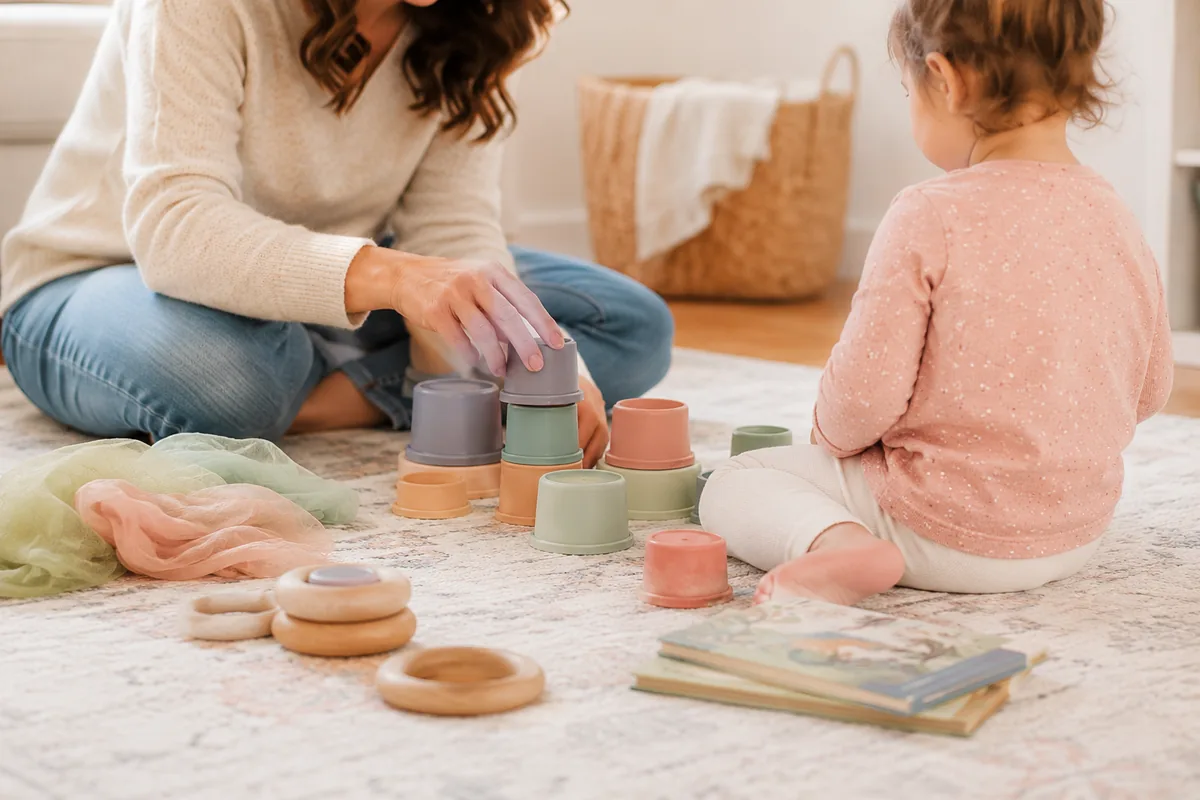
Babies this age love to build a small tower and then knock it down with great delight — sometimes faster than you can stack it. Use lightweight plastic cups or empty cardboard boxes to make stacking safe and easy. You can also try nesting cups inside one another, or rolling a soft ball back and forth to add a little turn-taking.
- A set of plastic cups or small empty boxes
- A soft ball
- A clear bit of floor space
Parent tip: Expect knocking down to be the main event for a while — that is part of the fun and the learning. Rebuild the tower with a cheerful "Again?" and let them lead the pace.
What it supports: Picking up, placing, and toppling supports hand-eye coordination and early reasoning through play, as your baby tests what happens when they let go.
Keeping Play Easy and Fun
You do not have to do all five of these in one day. Pick one that fits your mood and energy, keep sessions short, and remember that repetition is exactly how little ones learn. If your baby wanders off mid-activity, that is completely normal — their attention span is still growing. The goal is connection and curiosity, not finishing a checklist. A few minutes of unhurried, screen-free time with you is more than enough.
This article is for general parenting support and is not medical advice.