When you are a new parent, it can feel like every toy store shelf and social media feed is telling you that your baby needs more — more gadgets, more screens, more stimulation. The truth is beautifully simple: for babies in their first year, you are already the best toy in the room.
The ideas below are low-cost, low-pressure, and built around what your baby actually needs right now: your face, your voice, your warmth, and a world that feels safe to explore.
Why screen-free play matters in the first year
A baby's brain grows at a remarkable pace in the first twelve months. What fuels that development most is not a screen or a programmed toy — it is back-and-forth interaction with a caring adult. When you smile and your baby smiles back, when you talk and they babble in response, you are building the foundation for language, trust, and curiosity. Screens cannot replicate that live, responsive loop.
That does not mean you need to fill every waking minute with structured activity. Calm, everyday moments — a nappy change with funny faces, a walk narrated in your own words — count every bit as much as a dedicated "play session."
Tummy time: tiny effort, big payoff
Tummy time is one of the most recommended screen-free activities for young babies, and it costs nothing. Place your baby on their tummy on a firm, flat surface while they are awake and you are watching. Start with just two or three minutes and build up gradually as your baby gets stronger.
- Get down on the floor so your face is at their level — your face is the motivation to lift their head.
- Try tummy time across your lap or on your chest if your baby dislikes the floor at first.
- A rolled towel under their chest can make it feel more comfortable in early weeks.
Every child is different in how quickly they warm to tummy time. If you ever have concerns about your baby's comfort or development, your pediatrician is the best person to ask.
Five screen-free play ideas to try today
Peekaboo with your hands
Cover your face with both hands, pause for a beat, then reveal a big smile and say "peekaboo!" Even very young babies pick up on the anticipation, and by four to six months many will giggle in delight. Vary the pace — sometimes slow, sometimes quick — to keep them guessing.
Parent tip: Try it from slightly different distances. Close up feels cosy; a step back makes the reveal feel like a little surprise.
Why it helps: The back-and-forth rhythm of hide-and-reveal is one of the earliest forms of "conversation," building the expectation that responses follow actions.
Narrate your day out loud
Talk to your baby while you fold laundry, make breakfast, or walk to the letterbox. Describe colours, sounds, and what you are doing: "Now I am pouring the water — can you hear that? It sounds like rain." Your voice is the richest sound in your baby's world right now.
Parent tip: You do not need to use "baby talk" exclusively. Natural, varied speech — including the funny voices — is all good. The important thing is keeping the flow going.
Why it helps: Hearing a wide range of words and sounds in real, contextual moments lays the groundwork for your baby's own communication later on.
Soft texture exploration
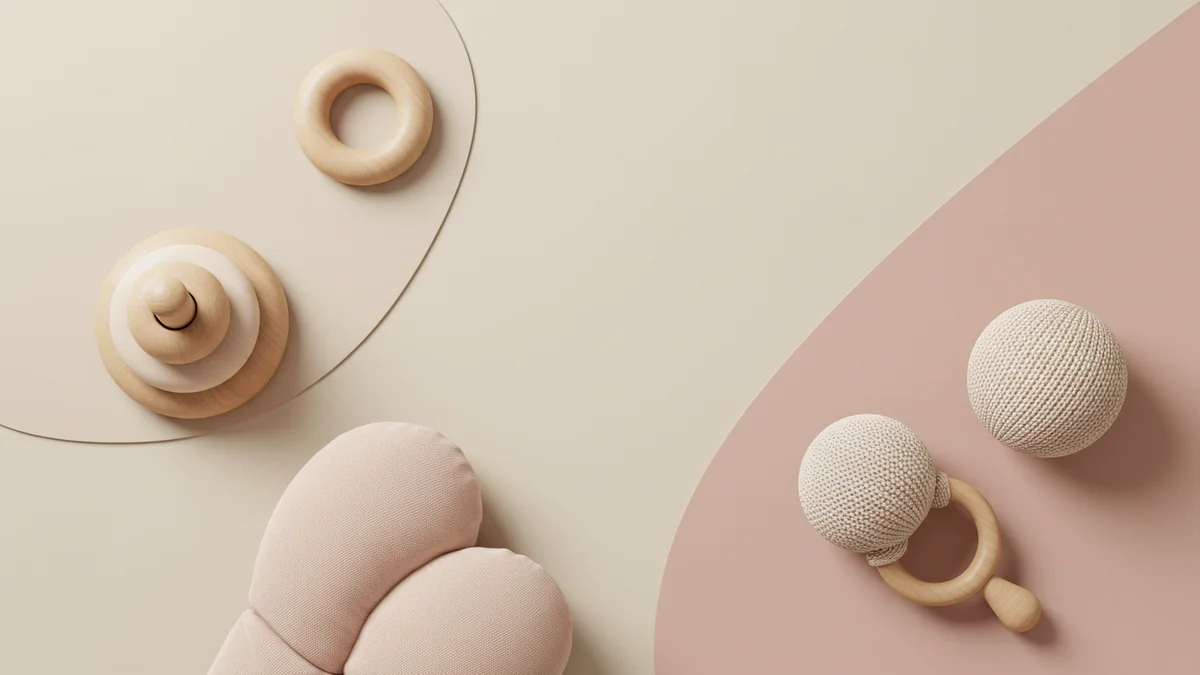
Gather a few safe, clean materials with different textures: a silky scarf, a soft knitted square, a smooth wooden spoon handle, a bumpy rubber bath mat. Let your baby touch and mouth them (always supervised) while you describe how each one feels: "This one is smooth. This one is fluffy and soft."
Parent tip: Keep pieces large enough that there is no choking risk, and put anything small safely away when play is done.
Why it helps: Touching different surfaces is one of the earliest ways babies learn that the world has variety — and that exploring it is safe and fun.
Mirror time
Hold your baby in front of a mirror (or use a soft, shatterproof baby mirror on the floor during tummy time). Make expressions together — wide eyes, open mouth, silly tongue — and watch your baby study the reflections with fascination.
Parent tip: Name the expressions as you make them: "That is a surprised face! And that is a happy face!" Simple, repeated labelling adds language alongside the fun.
Why it helps: Babies are captivated by faces, especially their own. Mirror play offers a gentle, self-directed way to explore expression and identity.
Singing and gentle movement
Hold your baby securely and sway, bounce gently, or rock to a simple song. It does not need to be a real nursery rhyme — hum a tune you like, or make one up with their name in it. The combination of rhythm, touch, and your voice is deeply soothing and engaging.
Parent tip: Repetition is not boring to a baby — it is reassuring. Singing the same song many times over weeks actually helps them recognise patterns and anticipate what comes next.
Why it helps: Rhythm and melody help babies process sound, and the physical closeness during movement strengthens the bond between you.
A note on "enough"
It is worth saying plainly: you do not need a curated activity schedule to give your baby a rich first year. Responsive, loving interaction — however it naturally fits into your day — is what matters most. Some days the only "play" is ten minutes of peekaboo between feeds. That is genuinely enough. Rest when you need to, and trust that the ordinary moments you share are building something wonderful.
This article is for general parenting support only and is not medical advice.