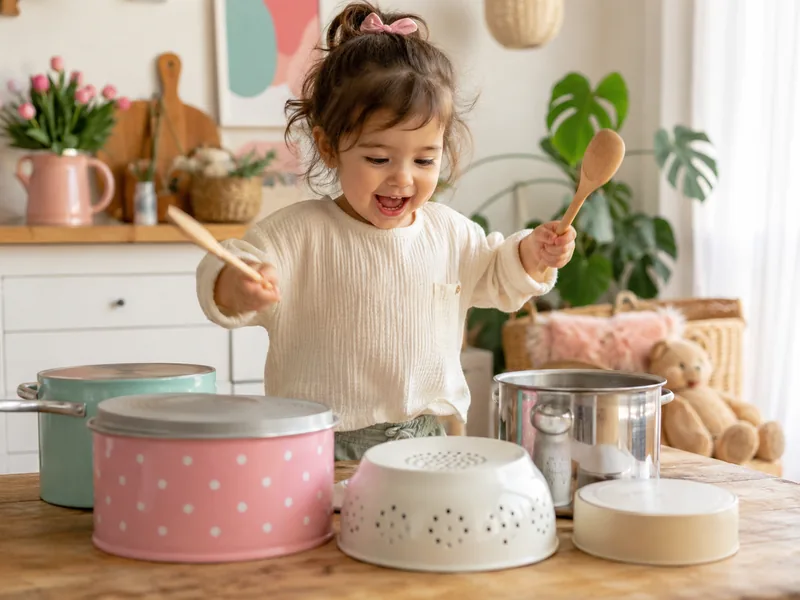
Most feelings-word advice shows up mid-meltdown, when your toddler is already face-down on the kitchen floor and nobody's brain is in a great spot to learn a new word. Feelings vocabulary actually builds best on the calm, boring, in-between days — long before anything goes sideways. Here's how to work it into everyday moments so your child already has a few words ready when a big feeling hits.
Why timing matters more than the word itself
When a toddler is mid-meltdown, their brain is flooded and simply not in listening mode — that's not a character flaw, it's just how big feelings work at that age. Any new word introduced right then has almost nowhere to land. But a word your child already knows well from calmer moments has a much better chance of surfacing when they need it, even if it comes out shaky or half-formed.
Name your own feelings out loud, often
One of the easiest ways to build this vocabulary is simply narrating your own emotions in ordinary moments: "I'm a little frustrated, this jar won't open." "I feel so happy watching you build that tower." Your child hears the word attached to a real feeling, on your face, in your voice — no lesson required, just you being a person out loud.
5 easy moments to slip a feelings word in
- During a book — "The bear looks scared here."
- Watching another child at the park — "She looks so excited!"
- After a small win — "You look proud of that!"
- During a small letdown — "Aw, disappointed the swing was taken?"
- At bedtime — "What was one happy thing today?"
Start with just a few words
You don't need a chart of twenty emotions. Happy, sad, mad, scared, and tired cover an enormous amount of daily life for a young child. Once those feel familiar, you can gently add more specific ones — frustrated, excited, disappointed, proud — the same way you'd add any new vocabulary, a little at a time.
Feelings words and everyday talking go hand in hand
This isn't a separate program from the rest of your child's language growth — it's the same daily narrating and naming you'd use for colors or animals, just pointed at the inside instead of the outside. The more comfortable your child gets naming a feeling on a calm Tuesday, the more likely that word is to show up on a hard one.
One simple way to build the habit
If you'd like a gentle daily nudge, ParentPilot AI offers short, parent-led missions — roughly five minutes each — built around ordinary moments like these. It's one small tool among many, not a replacement for the calm, everyday talking you're already doing with your child.
This article is for general parenting support and is not medical advice.