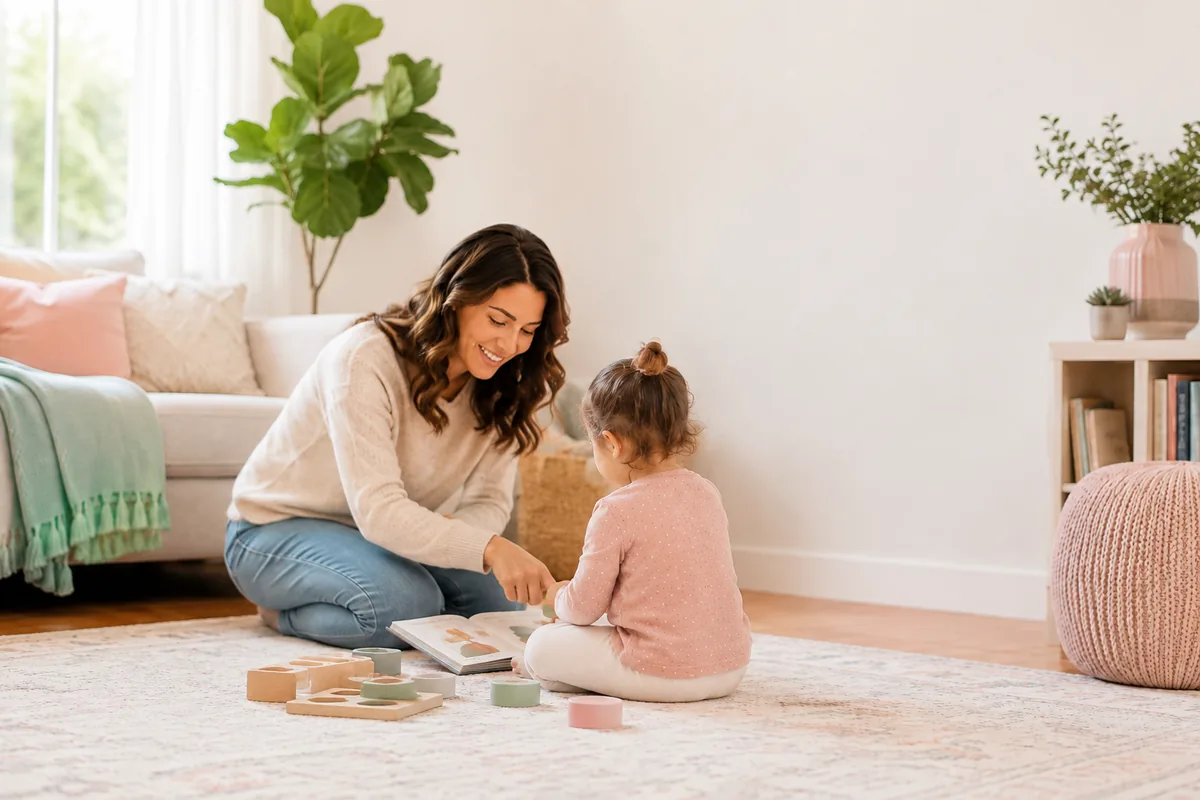
Raising a little one with both English and Vietnamese is one of the most loving gifts you can offer — and it doesn't have to mean flashcards, drills, or pressure. The everyday moments you already share, like playing on the floor, singing in the car, or naming food at dinner, are exactly where two languages can grow side by side. This is meant to be warm and gentle, not a test. Follow your child's lead, keep it playful, and let both languages live in the small things you do together.
You may worry that mixing English and Vietnamese will "confuse" your child, or that you have to get the balance perfect. You don't. Children are wonderfully flexible, and play is one of the most natural ways to give them exposure to both languages. The ideas below are simple, low-prep, and built for ages 0–5. Pick one that fits your day, sprinkle in a few words from each language, and enjoy it.
The bilingual play ideas at a glance
Narrate your day in both languages
A few minutes · just your voice
Songs, rhymes, and gentle music
5–10 min · a song or two
Label household objects together
5 min · one room at home
Mealtime words
Throughout a meal · a snack or meal
Picture-book play
5–15 min · any picture book
One-parent-one-language
Ongoing · a loose plan
Narrate your day in both languages
As you move through ordinary moments — changing a diaper, pouring water, putting on shoes — talk through what you're doing, and offer the word in both languages. "Here's your milk / sữa." "Time for a bath / tắm." Your child hears the same idea twice, gently, with no quiz at the end.
- Just your voice
- An everyday routine
Parent tip: Pick one routine (say, mealtime) to be your "both languages" moment so it feels natural rather than forced.
This supports language exposure through play by letting your child hear both languages tied to real, familiar actions.
Songs, rhymes, and gentle music
Singing is play that two languages love. Try an English rhyme one round and a Vietnamese one the next — "Twinkle, Twinkle" followed by "Bắc Kim Thang" or "Cò Lả." Clap, sway, and add silly gestures. Babies who can't talk yet still soak in the rhythm and sounds of both languages.
- A song or two you remember
- Your hands for clapping
Parent tip: Ask grandparents for the Vietnamese lullabies they sang — it's a sweet way to pass songs across generations.
This supports language exposure through play by pairing the melody and feel of each language with cuddles and movement.
Label household objects together
Walk slowly around one room and name a few things in both languages as you touch them: door / cửa, chair / ghế, light / đèn. With toddlers, turn it into a gentle game — "Can you find the cửa?" Keep it short and let your child point, repeat, or just watch.
- One room at home
- A few everyday objects
Parent tip: Don't correct pronunciation — just warmly repeat the word back so your child hears it again naturally.
This supports language exposure through play by connecting words in both languages to objects your child can see and touch.
Mealtime words
Dinner is a goldmine of friendly vocabulary. As you eat, name foods and feelings in both languages: rice / cơm, water / nước, more / thêm, all done / hết rồi. When your child reaches for seconds, you might say "Oh, you want more / thêm?" — turning a real moment into language they care about.
- A regular meal or snack
- A relaxed pace
Parent tip: Words tied to what your child wants right now ("more," "thêm") tend to stick because they're useful and rewarding.
This supports language exposure through play by linking both languages to food, choices, and shared family time.
Picture-book play
You don't need a bilingual book to read bilingually. Open any picture book and point to the images, saying the word in English and then in Vietnamese: "A dog / chó!" "Look, a fish / cá." Let your child turn pages, point, and "read" to you. There's no wrong order and no need to finish the story.
- Any picture book
- A cozy spot to sit
Parent tip: Re-reading the same favorite book is great — the repetition gives both languages a chance to settle in.
This supports language exposure through play by adding both languages to the calm, bonding ritual of looking at pictures together.
One-parent-one-language (and other gentle approaches)
Some families find it helpful when each parent leans into one language — perhaps one speaks mostly Vietnamese and the other mostly English. Others mix freely, or speak Vietnamese at home and let English come through play, school, and friends. Any of these can work. Choose what feels sustainable for your household, and know you can adjust as your child grows.
- A loose plan you can keep up
- A little patience with yourself
Parent tip: If today was an all-English or all-Vietnamese day, that's completely fine. Tomorrow is another chance.
This supports language exposure through play by giving each language a comfortable, regular place in family life.
This article is for general parenting support and is not medical advice.