If you've found yourself quietly counting your toddler's words, or comparing them to the chatty kid at the park, take a breath — you're not alone, and you're not doing anything wrong. Children learn to talk on wildly different timelines, and a slower start is often just that. This guide walks through what's typical at a few key ages, what's gently worth watching, and seven warm, everyday ways to support your little one's talking right at home.
One thing first: this article is here to reassure you and give you practical things to try, not to label your child. The ranges below are friendly guideposts, not pass-or-fail tests. The most useful thing you can do isn't to worry harder — it's to keep talking, playing, and tuning in to your child. Let's start with each age.
Age-by-age: what's typical and when to gently watch
Think of these as soft windows, not deadlines. Many children land outside a range for a while and catch up beautifully on their own.
Around 12 months
Often typical: babbling that sounds like real conversation ("ba-ba-da-da"), responding to their name, using gestures like waving or reaching, and maybe a first word or two. Pointing and "showing you" things counts as communication, even without words.
Gently worth watching: very little babbling, no gestures at all, or a baby who doesn't seem to respond to sounds or their name. It's worth mentioning at the next visit — mostly so hearing can be checked, which is easy to rule out.
Around 18 months
Often typical: a handful of words (often around 10–20, though it varies a lot), pointing to show you something interesting, following a simple instruction like "give me the ball," and trying to copy words you say.
Gently worth watching: no words at all, no pointing to share interest, or a child who doesn't seem to be trying to communicate. If your gut says something feels off, that quiet feeling is worth a conversation with a professional.
Around 2 years
Often typical: a growing word collection and beginning to put two words together ("more milk," "daddy go"). You might understand roughly half of what they say — strangers, less so, and that's normal at this age.
Gently worth watching: not combining two words yet, a very small word count, or losing words they used to say. Loss of skills, in particular, is always worth raising promptly.
Around 3 years
Often typical: short sentences, asking lots of questions, and being understood most of the time by familiar adults. Pronunciation is still a work in progress, and that's expected.
Gently worth watching: speech that's very hard for family to understand, no short phrases, or big frustration around communicating. Again, this is a "let's check in" signal, not a diagnosis.
7 gentle home strategies to support talking
These cost nothing, fit into the day you already have, and work whether your child is a chatterbox or just warming up.
Narrate your day
Talk out loud about whatever you're doing — "I'm pouring the water… all done… now we wash our hands." It feels silly at first, but it bathes your child in language tied to real actions. No response needed; you're filling the air with words they can borrow later.
This gives your child a steady stream of everyday words connected to things they can see and touch.
Read aloud, every day
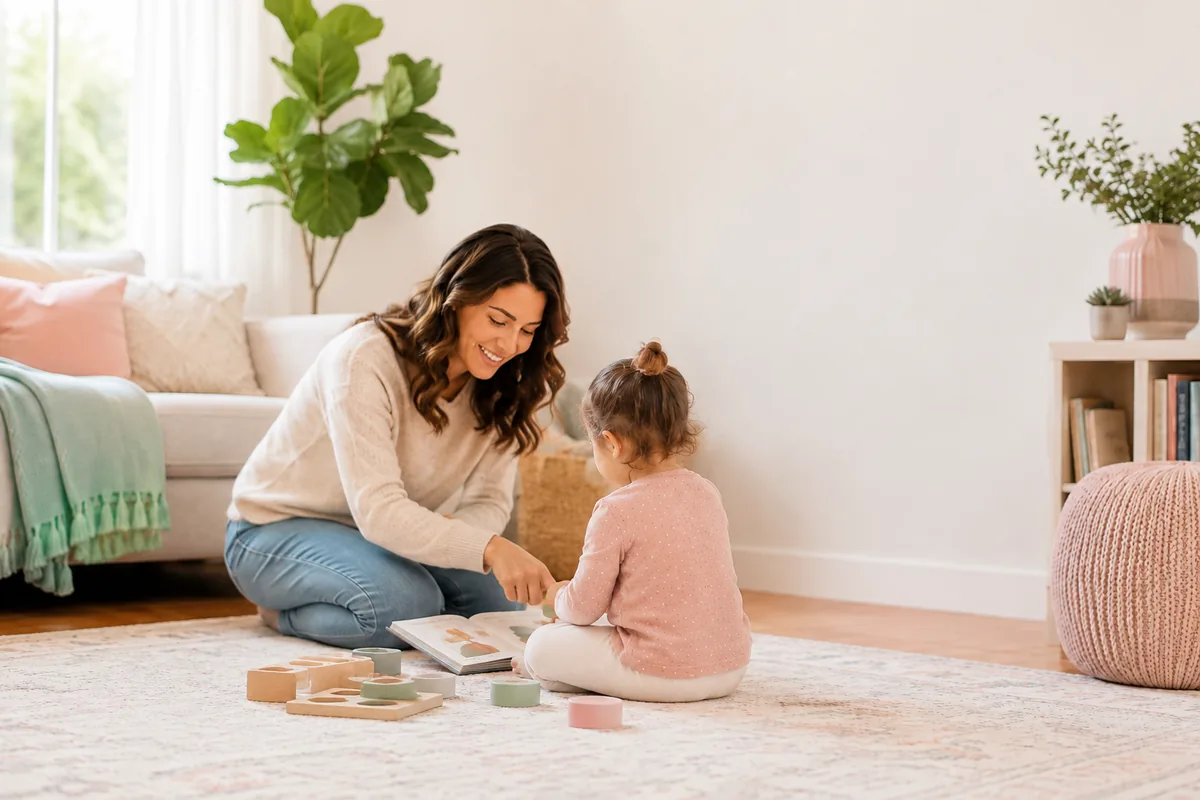
Even five minutes counts. Point to pictures, name what you see, and let your child turn the pages or "read" to you. Don't worry about finishing the book — re-reading the same favorite is wonderful, because repetition is how words settle in.
Sharing books links words to pictures and turns reading into a cozy, language-rich ritual.
Sing songs and rhymes
Songs are talking with training wheels. The rhythm, repetition, and gestures of "Twinkle, Twinkle" or "The Wheels on the Bus" make words easier to grab. Pause before the last word of a familiar line and see if your child fills it in — a tiny, joyful invitation to talk.
Melody and repetition make sounds and words easier for your child to catch and try.
Give choices and wait
Instead of guessing, offer two options — "banana or apple?" — then wait. That little silence can feel long, but it gives your child space to point, gesture, or say a word. Waiting a few extra seconds is one of the most underrated talking tools there is.
Offering choices and pausing gives your child real reasons and room to communicate.
Expand what they say
When your child says "dog," you say "Yes, a big dog!" When they say "go," you say "Go fast!" You're not correcting — you're gently adding a piece. This shows your child the next step up without any pressure or quizzing.
Building on your child's words models the next step in a warm, low-pressure way.
Reduce background screens
A TV humming in the background can make it harder for little ears to pick out your voice — the one that teaches them most. Turning it off during play and meals just clears the air so your conversation can shine. (To be clear: screens don't cause developmental conditions — this is simply about giving your voice room to be heard.)
A quieter background helps your child focus on the live, back-and-forth talk that helps most.
Play face-to-face
Get down on the floor, at eye level, and follow your child's lead. When they can see your mouth, eyes, and expressions, they pick up far more than words alone. Roll a ball back and forth, take turns, and let the play do the talking — connection comes first, and language rides along with it.
Eye-level, back-and-forth play builds the connection that talking grows out of.
This article is for general parenting support and is not medical advice. If you have concerns about your child's speech or hearing, please see your pediatrician or a speech-language professional for assessment.