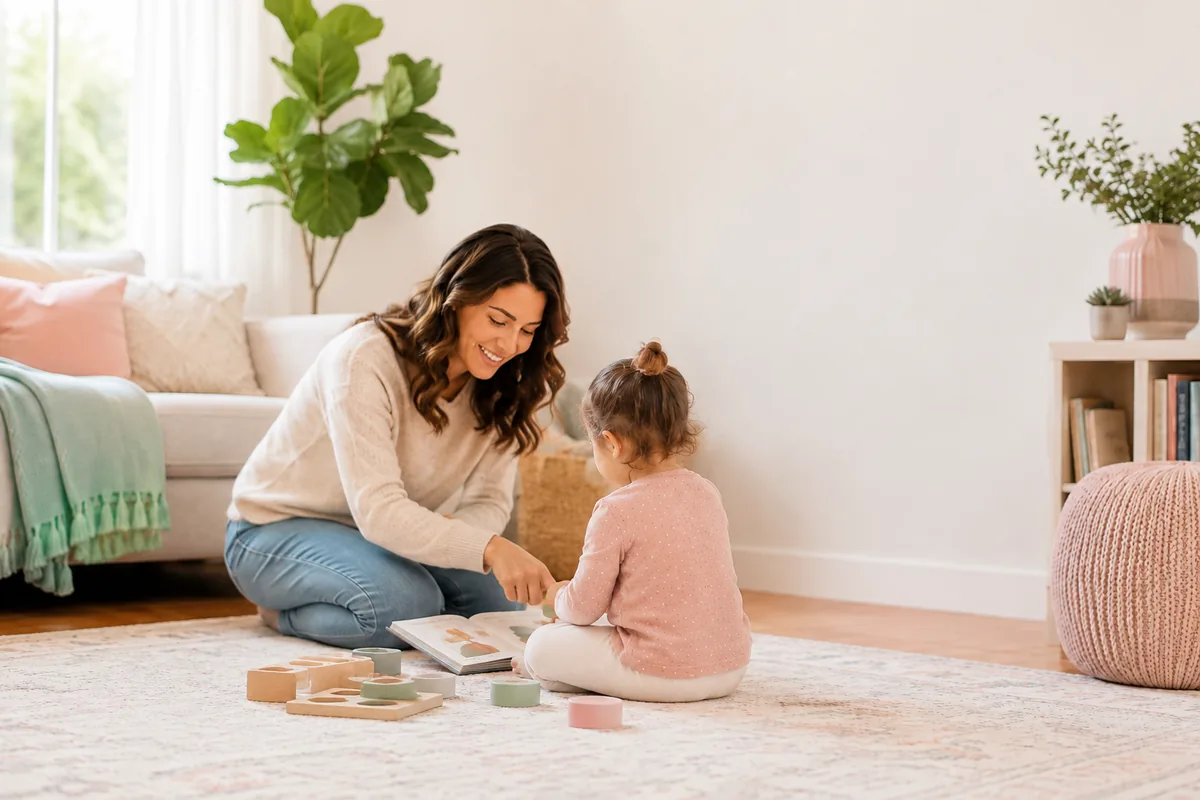
You don't need an hour of lessons, a classroom, or perfect English to teach your toddler English at home. What young children respond to most is short, warm, repeated exposure — a few familiar words sprinkled into moments you already share. Fifteen minutes a day, woven into your normal routine, can do far more than a long weekend "lesson" your child sits through and forgets. This is about gentle exposure and a small daily habit, not a test, and your little one is never being graded.
The biggest myth is that you have to speak English fluently, with a flawless accent, before you can begin. You don't. A toddler isn't judging your grammar — they're watching your face, hearing your tone, and feeling safe enough to listen and try. Warmth matters more than accent. If you say a word a little differently than a recording, that's completely fine. Your child gets to hear English from someone who loves them, and that connection is what makes new sounds feel friendly instead of scary.
Why 15 minutes beats a long lesson
Little children learn in tiny, repeated doses, not long sittings. A 45-minute session usually means a tired, wiggly toddler and a tired parent — and most of it slips away. But a handful of English words tied to real, daily moments come back again and again, naturally. Hearing "all done" every single time the plate is empty teaches it far better than ten minutes of pointing at a worksheet once a week. Short and steady wins, because the repetition does the work for you.
Four daily anchors (and what to say)
Bath time
A few minutes · "wash your hands"
Meal time
Throughout a meal · "more / all done"
Play time
5 min · "your turn"
Bedtime
A few minutes · "good night"
Bath time: actions you can see
Bath time is full of motions your child can watch, so the words stick to something real. Try a few simple lines: "Wash your hands." "Splash, splash!" "All clean." Say it while you do it, so the words and the action arrive together. Your toddler doesn't have to repeat anything — listening and watching is plenty for now.
- Just your voice
- The bath you already give
Parent tip: Pick two or three phrases and use the same ones every bath. Sameness is what helps them sink in.
This supports English exposure by tying short phrases to actions your child can see and feel.
Meal time: words your child wants
Meals are perfect because your child has real reasons to communicate. When they reach for seconds, offer the word: "Oh, you want more?" When the plate is empty, smile and say "All done!" Words tied to what your toddler wants right now — more food, finished, please — tend to stick fastest, because they're useful in that very moment.
- A regular meal or snack
- A relaxed pace
Parent tip: Pair the English word with a little gesture — open hands for "more," wiping motion for "all done" — so meaning is clear without translation.
This supports English exposure by linking simple words to choices your child cares about.
Play time: take turns together
Rolling a ball, stacking blocks, or feeding a toy are great for one tiny phrase used over and over: "Your turn." "My turn." "Ready, go!" Play is relaxed and joyful, so English arrives with laughter instead of pressure. Let your child point, hand you a toy, or just watch — there's no need to make them say the words back.
- A ball or a few blocks
- A bit of floor space
Parent tip: If your child only listens and never speaks yet, that's normal. Understanding always comes before talking.
This supports English exposure by wrapping a couple of repeated words in something your child already enjoys.
Bedtime: a calm, repeated close
The end of the day is calm and predictable, which makes it perfect for a soft, repeated phrase: "Good night." "I love you." "See you in the morning." You might say good night to a few toys too — "Good night, teddy." The gentle repetition, night after night, lets these warm words settle in without any effort.
- Your goodnight routine
- A favorite stuffed toy (optional)
Parent tip: Keep the same closing phrase every night so it becomes a comforting little ritual your child can predict.
This supports English exposure by attaching kind, familiar words to the calm of winding down.
Add songs and "learning by doing"
Songs are some of the easiest English a toddler will ever absorb — the melody carries the words for them. A round of "Twinkle, Twinkle" or "Head, Shoulders, Knees and Toes" gives lots of repetition with zero pressure. Pair words with movement, too: when you say "jump," jump; when you say "clap," clap. This "learning by doing" lets your child show they understand with their body long before they can say a word out loud, which keeps it playful and removes the fear of getting it "wrong."
Let your child listen and point first
There is no rush to make your toddler speak. For a long while, the real learning is quiet: listening, watching your mouth, pointing at the right picture. If you ask "Where's the dog?" and your child points, that's a win — they understood. Never turn it into a quiz or correct their pronunciation. Just warmly repeat the word back so they hear it again. Speaking blooms on its own timeline, and pressure only makes it slower.
Keep Vietnamese strong, too
Adding English does not mean dropping Vietnamese — and it shouldn't. Your child's mother tongue is the foundation for their thinking, their family bonds, and even their English later on. Keep speaking Vietnamese warmly and fully at home, and let English be the lighter sprinkle on top through these little daily moments. It is completely normal for bilingual children to mix the two languages in one sentence or lean toward one for a while. Both can grow side by side.
One simple way to do it
If you'd like a little structure, ParentPilot AI offers short, parent-led missions — roughly five minutes each — that you do together with your child. They're a calm, honest way to build the daily habit described here: a few familiar words, a small shared activity, no screens doing the work for you. It's one option among many, not a replacement for your own warm, everyday talking, which will always be the best part.
This article is for general parenting support and is not medical advice.