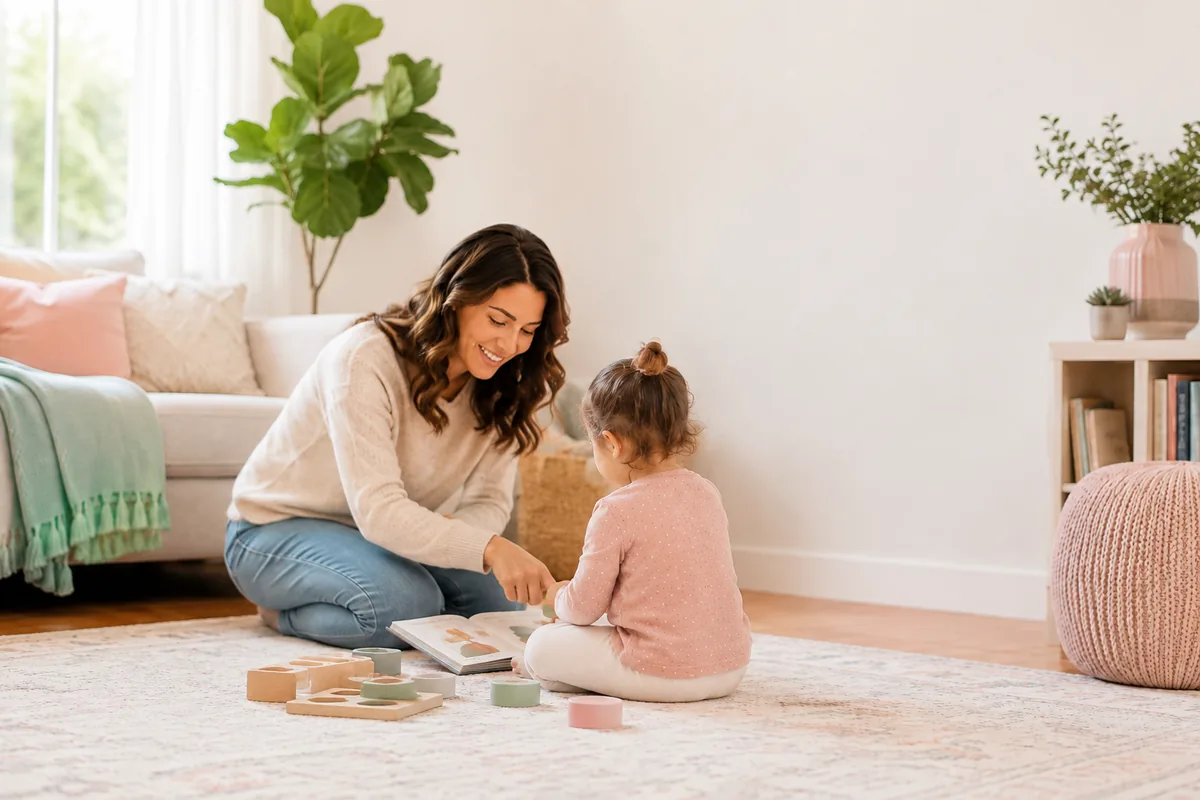
The easiest everyday English phrases for toddlers are the ones you already have a reason to say — at breakfast, in the bath, on the way out the door. When a short line lands at the exact moment it makes sense, your child hears the words and sees what they mean at the same time. Below are 30 natural phrases grouped by daily routine. You don't need to use them all; pick a few that fit your day and let them repeat themselves. Save this page or print it and stick it on the fridge.
Three small rules make these work. First, say it at the real moment — "Time to eat!" as you sit down, not as a lesson later. The word and the action arrive together, so the meaning is obvious and nobody has to translate. Second, keep it short; a toddler catches three or four words far more easily than a full sentence, and short lines are easy for you to remember and reuse. Third, no pressure to repeat — listening is learning, and understanding always comes before talking. Your child is never being graded, and a quiet day is still a good day.
Waking up & getting dressed
The start of the day is gentle and predictable — perfect for a few warm, repeated lines.
- Good morning!
- Did you sleep well?
- Time to get up.
- Arms up!
- Let's get dressed.
Mealtime
Meals give your child real reasons to communicate, so these words tend to stick fast.
- Time to eat!
- Are you hungry?
- Do you want more?
- All done!
- It's yummy!
Bath time
The bath is full of actions your child can watch, so the words attach to something real.
- Time for a bath.
- Wash your hands.
- Splash, splash!
- All clean.
- Let's dry off.
Play time
Play is relaxed and joyful, so English arrives with laughter instead of pressure.
- Your turn.
- My turn.
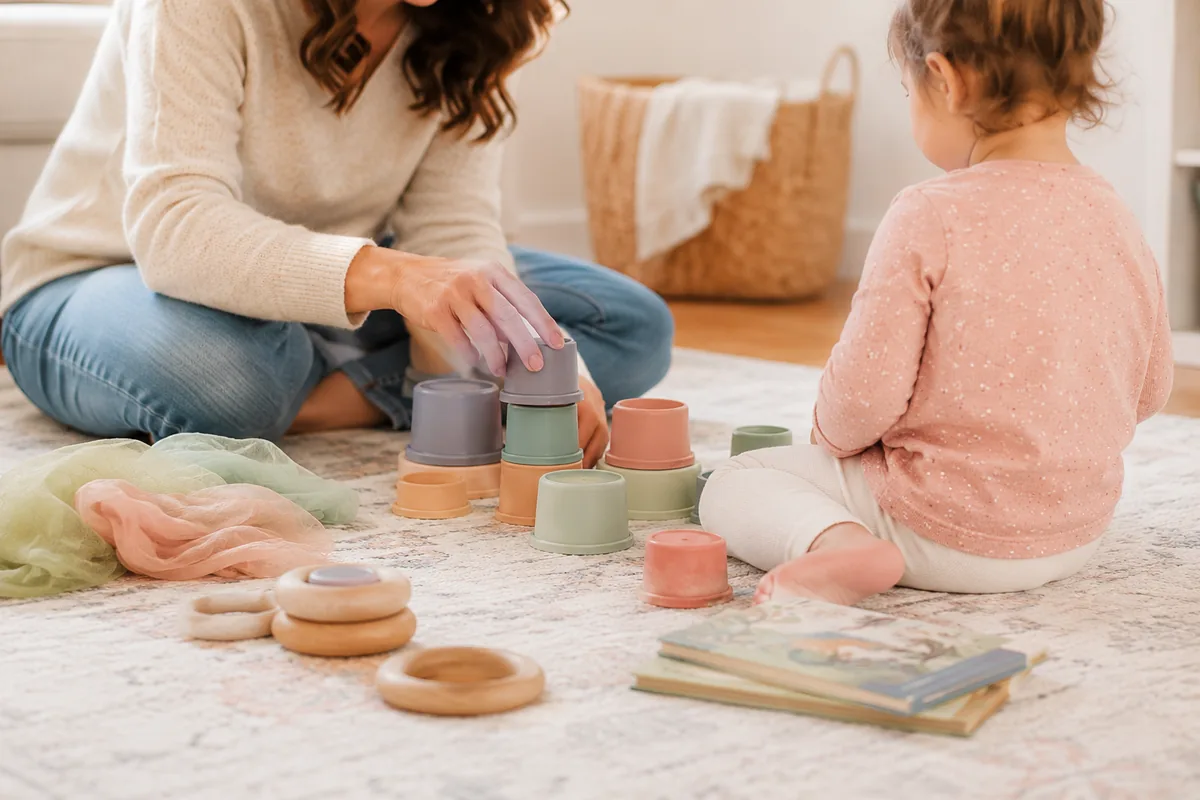
- Let's build a tower.
- Good job!
- Let's clean up.
Going out
Getting ready and stepping outside is busy, so a handful of clear, friendly lines help.
- Let's go outside.
- Put your shoes on.
- Hold my hand.
- Look at the bird!
- We're home.
Bedtime
The end of the day is calm and predictable — ideal for soft, repeated words.
- Time for bed.
- Brush your teeth.
- Let's read a book.
- Good night.
- I love you.
How to use the list (without it feeling like work)
Don't try to "teach" all thirty at once. Choose one routine — say, mealtime — and use its five phrases for a week. Because the meal happens every day, your child hears the same words again and again with no effort from you, and the repetition does the real work. Once those feel familiar, add the next routine, and the earlier phrases keep coming back on their own. Pair words with a small gesture where you can — open hands for "more," a little wave for "all done," pointing at the shoes for "put your shoes on" — so meaning is clear without stopping to translate.
If your child only listens and never repeats yet, that's exactly right for now. You can gently invite a response — "Do you want more?" with a pause and a smile — but never turn it into a quiz or correct their pronunciation. Just warmly say the phrase again so they hear it once more. Speaking comes on its own timeline, and pressure only slows it down.
Keep Vietnamese strong, too
Sprinkling in English doesn't mean stepping back from Vietnamese — and it shouldn't. Your child's mother tongue is the foundation for their thinking, their family bonds, and even their English later on. Keep speaking Vietnamese warmly and fully at home, and let these English phrases be the lighter sprinkle on top. It's completely normal for bilingual children to mix the two in one sentence; both can grow side by side.
One simple way to do it
If you'd like a little structure, ParentPilot AI offers short, parent-led missions — roughly five minutes each — that you do together with your child. They're a calm, honest way to build the daily habit described here: a few familiar words, a small shared activity, no screens doing the work for you. It's one option among many, not a replacement for your own warm, everyday talking, which will always be the best part.
This article is for general parenting support and is not medical advice.